Research
My research is in theoretical condensed matter physics, with emphasis on emergent phenomena in interacting and disordered quantum systems. I use effective lattice Hamiltonians and numerical many-body methods to investigate how electron-electron, electron-phonon, and electron-photon interactions generate or reshape magnetism, superconductivity, charge order, quantum criticality, topology, and electronic transport.
Current research spans strongly correlated systems, electron-phonon physics, quantum criticality and semimetals, disorder and localization, and cavity quantum materials.
Strong correlations · Disorder & transport · Cavity quantum materials · Methods
Strongly correlated quantum systems
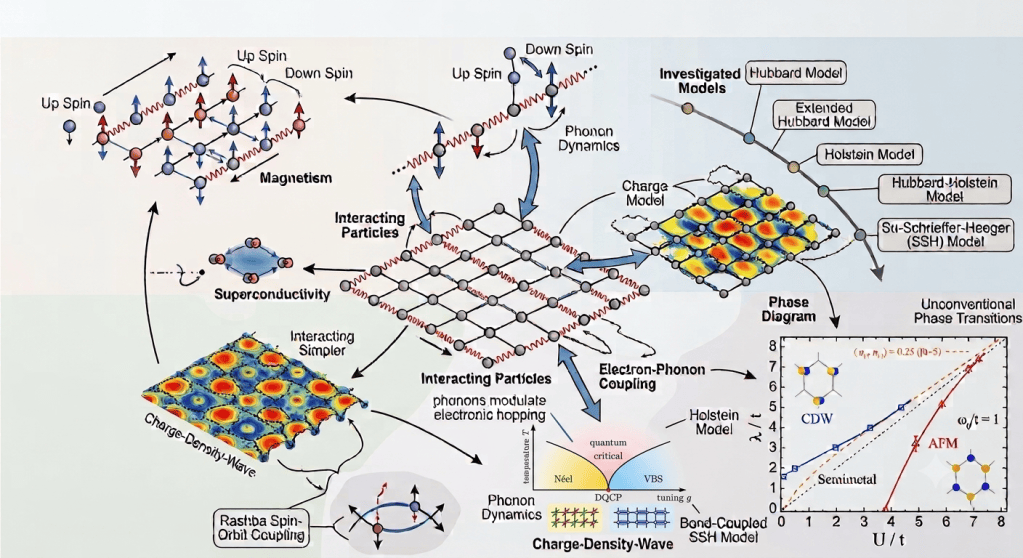
A central theme of my research is understanding how collective states emerge from competing interactions in low-dimensional quantum systems. I use effective lattice models, including the Hubbard and extended Hubbard models, the attractive Hubbard model, periodic Anderson and Kondo-lattice models, as well as Holstein, Hubbard-Holstein, and Su-Schrieffer-Heeger models, to investigate magnetism, superconductivity, charge-density-wave order, valence-bond phases, and metal-insulator behavior. A particular focus is the interplay between electron-electron and electron-phonon interactions and how lattice geometry, phonon dynamics, disorder, and spin-orbit coupling reshape ordered phases and their competition or coexistence. These systems also provide a natural setting for exploring unconventional quantum phase transitions. In particular, I investigate deconfined quantum criticality in electron-phonon systems, including transitions between valence-bond and magnetically ordered states, with the goal of identifying critical behavior beyond the conventional Landau-Ginzburg framework and possible enlarged or emergent symmetries. Another current direction concerns interacting nodal semimetals, especially nodal-line systems in which conduction and valence bands touch along extended lines rather than isolated Dirac or Weyl points. In this context, I study which ordered phases emerge from electronic correlations, how interactions and disorder modify the nodal structure, and how the resulting critical behavior compares with that of Dirac semimetals. More broadly, these problems provide controlled settings for connecting microscopic interactions to emergent long-range order, quantum criticality, and experimentally relevant phase diagrams in correlated and quasi-two-dimensional materials.
Examples: Hubbard and extended Hubbard models · attractive Hubbard model · periodic Anderson and Kondo-lattice systems · Holstein model · Hubbard-Holstein model · Su-Schrieffer-Heeger model
Disorder, localization, and quantum transport

Disorder introduces a second source of complexity into quantum many-body systems by competing with long-range order and by modifying the spatial character of electronic states. I study how randomness affects correlated phases, metal-insulator transitions, and transport, with particular interest in Anderson localization and quantum percolation. These problems connect interference, geometry, correlations, and dimensionality in a common framework.
A related direction concerns electronic and thermoelectric transport in interacting systems. Here the aim is to understand how correlations reshape the carriers and their response functions, including anomalous behavior of the Seebeck coefficient. Transport calculations also provide a natural diagnostic of localization-delocalization transitions in mesoscopic and disordered systems.
Examples: Anderson localization · quantum percolation · disorder in correlated phases · metal-insulator transitions · conductance and thermopower
Cavity quantum materials and light-matter coupling
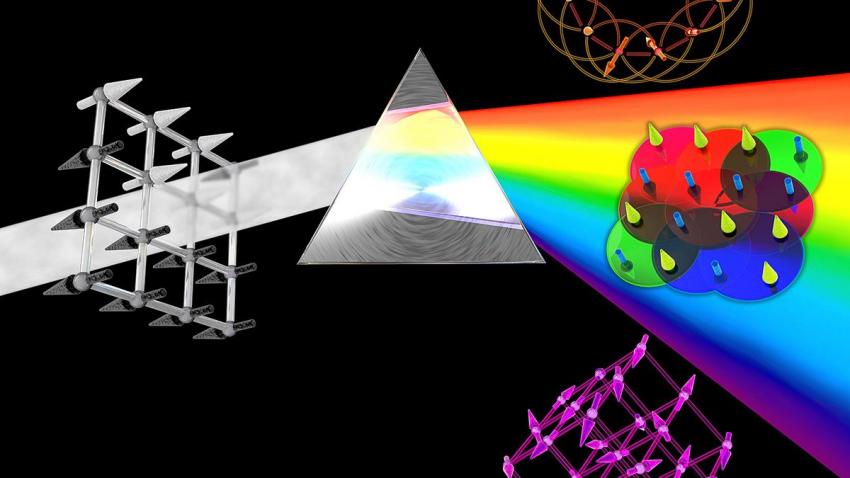
An increasingly important part of my research lies at the interface of condensed matter physics and cavity quantum electrodynamics. Strong coupling to quantized electromagnetic modes can generate photon-assisted processes, renormalize electronic parameters, and modify collective excitations. We investigate whether the cavity field can actively reshape phases of matter or instead provide a sensitive probe of the correlations already present in the electronic system.
Current problems include the effect of cavity coupling on interaction-driven quantum critical points, localization-delocalization transitions, quantum percolation, and topological states. We are particularly interested in disordered low-dimensional systems, where light-matter coupling may change localization lengths and critical disorder thresholds, producing hybrid regimes of electronic and photonic transport. We also explore nonlinear optical responses, such as higher-harmonic generation, as possible probes of phase transitions.
Examples: strong and ultrastrong light-matter coupling · cavity-modified quantum criticality · disordered cavity systems · photon-assisted transport · topological states · nonlinear response
Methods

My work is primarily computational and combines complementary numerical techniques according to the physical problem. A major component is auxiliary-field and determinant quantum Monte Carlo, which allow unbiased investigations of interacting lattice fermions whenever the sign problem can be controlled. These calculations are complemented by exact diagonalization and Lanczos methods for finite quantum systems.
For transport problems, I use Landauer-Büttiker approaches and nonequilibrium Green’s functions to obtain conductance and transmittance in mesoscopic systems. The numerical work relies extensively on high-performance computing, and selected projects also make use of data-analysis and machine-learning techniques.
Methods: AFQMC / DQMC · exact diagonalization · Lanczos · Landauer-Büttiker transport · nonequilibrium Green’s functions · high-performance computing
For articles associated with these research directions, see the Publications page.
 Natanael C. Costa